Safety is Paramount
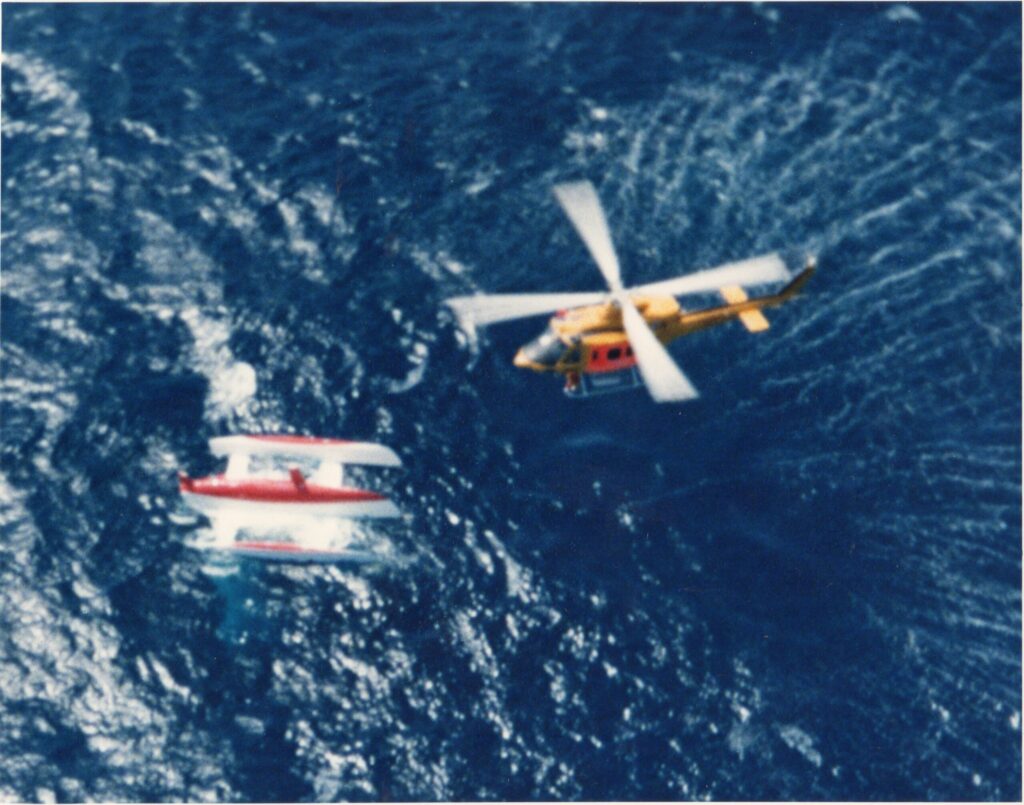
The 1988 event had incidents consequently, SHORAA intends to have a very high degree of risk mitigation and to take a precautionary approach in running the event.
We expect all Entrants to similarly exhibit a very high degree of safety and risk management in boat preparation, safety equipment carried, navigation, and overall ethos throughout the race.
Yacht Suitability
In addition to the eligibility requirements, each Yacht must be justified as fit for long passages offshore of Australia’s remote and rugged coastline and for a Southern Ocean passage well offshore of land. The yacht’s design must be proven offshore-capable or with suitable design certification for the rugged offshore course. The requirements of Section 3, Part 1 of the Special Regulations for Category 1 are considered an absolute minimum, with a precautionary approach applied to considering the rugged conditions of the race.
Yacht Construction, Stability and Equipment
Each yacht must meet Category 1, plus:
- YB tracker or similar (provided by Organizer)
- Additional GPS-EPIRB or GPS-PLB packed in liferaft
- A handheld VHF with spare batteries is recommended to be packed in liferaft
- Personal combined PLB with AIS/EPIRB for each Crew Member, and one spare
- One complete spare lifejacket/harness required
- Four three-point tethers required
- Emergency battery separate to house for 12 hours of AIS, autopilot, essential navigation, and communications systems
- AIS masthead-mounted aerial with low loss cable
- Spare AIS antenna ready for immediate deployment at deck level
- INMARSAT/Iridium/Starlink or similar always-on satellite device for email/WhatsApp messaging and voice connection
- Secondary handheld satellite phone (Iridium or ISATPHONE) or equivalent
- Anchor chain, minimum 25 m
- Anchor roller, snatch block or similar on bow/bowsprit/forebeam, with accessible anchor and cable stowage, capable of one-person deployment and retrieval of anchor
- All mainsail clew reefing lines must be reeved at the start of each Leg
- Multihulls: drogue and parachute compulsory
- Monohulls: drogue compulsory
- Emergency steering system in the event of loss of rudder must be installed, fully functional and ready for immediate deployment. This may include emergency rudder on transom or drogue with dedicated warps and anti-chafe system for bridle, or another demonstrated system.
- Motoring range 200 nm minimum (the NOR may extend or reduce this for some Legs). Fuel carried must allow for engine charging/hydraulic power in addition to the 200 nm range.
- Electrical system must have two mechanisms each capable of generating power for navigation and autopilot (e.g. diesel engine alternator and solar, wind, or hydro).
- Inflatable or solid dinghy with a means of propulsion (at least paddles) carried.
- RADAR recommended for collision avoidance and weather monitoring.
- Sea Survival suits are required.
- Water-tight bulkheads in the bow and stern are recommended.
- A gaiter on the rudder bearing(s) is recommended.
- A water-tight bulkhead between a saildrive through hull or stern gland and the main accommodation in that hull is recommended.
Crew Training
The Crew is to comprise one Person in Charge and one Crew Member. The Person in Charge has ultimate responsibility. However, both Crew should have awareness of all aspects of actions and responsibility for the Yacht’s safety, navigation, and communications. They must have current and valid:
- Sea Survival training; and
- Offshore Medic (3-5 day course not basic first aid).
Section 2.04 of Australian Sailing’s Special Regulations (SR) states:
“CREW EXPERIENCE The number of crew specified below, including the skipper and/or person in charge shall have completed one race of the category entered or an equivalent passage. Evidence of such shall be provided if requested by the race committee.“
The Notice of Race will amend this requirement to recommending that both Crew have experience in Category 1 or 2 races prior to the event, with the 500 nm qualifying voyage being considered as meeting the experience required under Section 2.04 of the SR.
To avoid any doubt a single Person in Charge must be nominated and will be identified as the Captain, the combined crew may be referred to as co-skippers.
Qualifying Voyage
Both Crew Members must have completed the same 500 nm non-stop passage on the entered yacht (including at least 75 nm offshore from land) within 150 days of but 30 days prior to the Race Start. The voyage must be logged and have some form of live, real-time tracking (e.g PredictWind, Garmin, NoForeignLand etc.). Race Director is to be provided prior notification of this passage, and given monitoring link/information for the tracker. Five still pictures, a 2 minute video of the passage and 250 word description of the voyage is required (as “media training”).
The Yacht must be essentially in the configuration it will be sailed in the Race Round Australia during this Qualifying Voyage.
It is recommended that the Qualifying Voyage be undertaken with a Category 1 Certificate, but it is recognized that it is the Person in Charge’s responsibility for the safety of the Qualifying Voyage and it is not an event organized by SHORAA. If no actual certificate has been obtained prior to the Qualifying Voyage, the Person in Charge must sign a full Cat 1 checklist and provide this to the Race Director prior to the Qualifying Voyage.
Both Crew sailing the entered Yacht in the doublehanded division of the Rolex Sydney to Hobart Yacht Race 2027 will be accepted as the Qualifying Voyage. However, the media requirements must still be met in some form as agreed with the Race Director.
Safety Certificates and Inspections
Each Yacht must provide an Australian Sailing Category 1 certificate issued within three months of the Race Start.
In the two weeks before the Race Start:
- The Cat 1+ items audited.
- Crew to demonstrate all communications devices fully functioning.
- Crew to demonstrate storm sails, drogue and parachute use and emergency steering system.
- Crew to explain MOB notification and recovery procedures.
- Crew to explain safety plan and location of key equipment.
- Other aspects will be randomly checked.