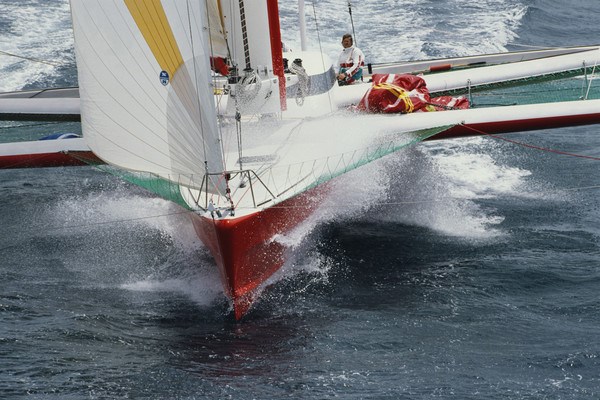
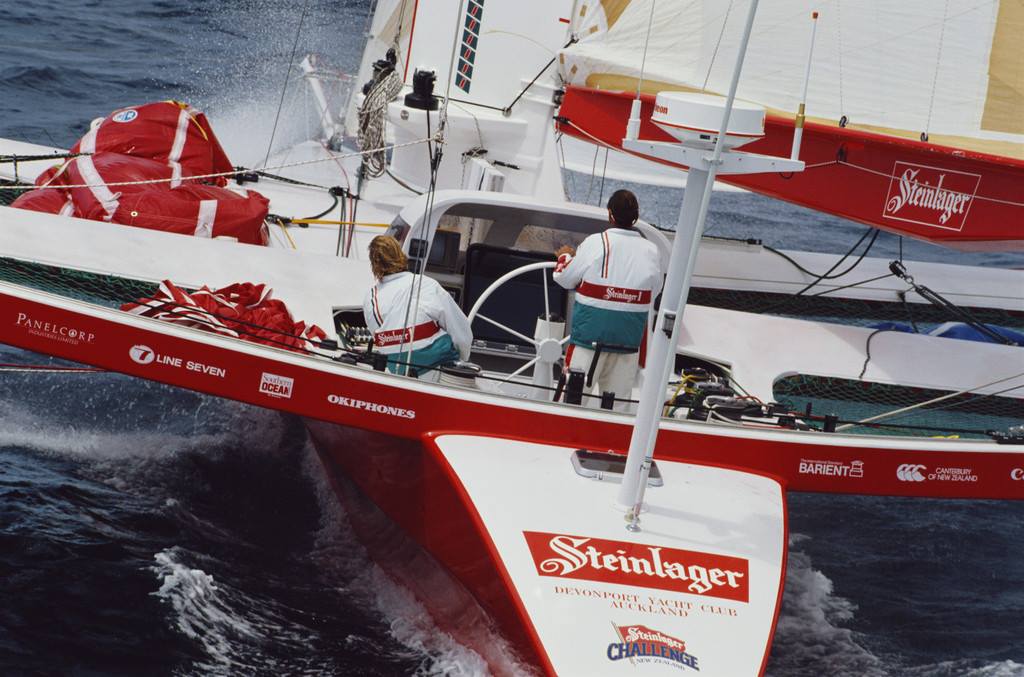
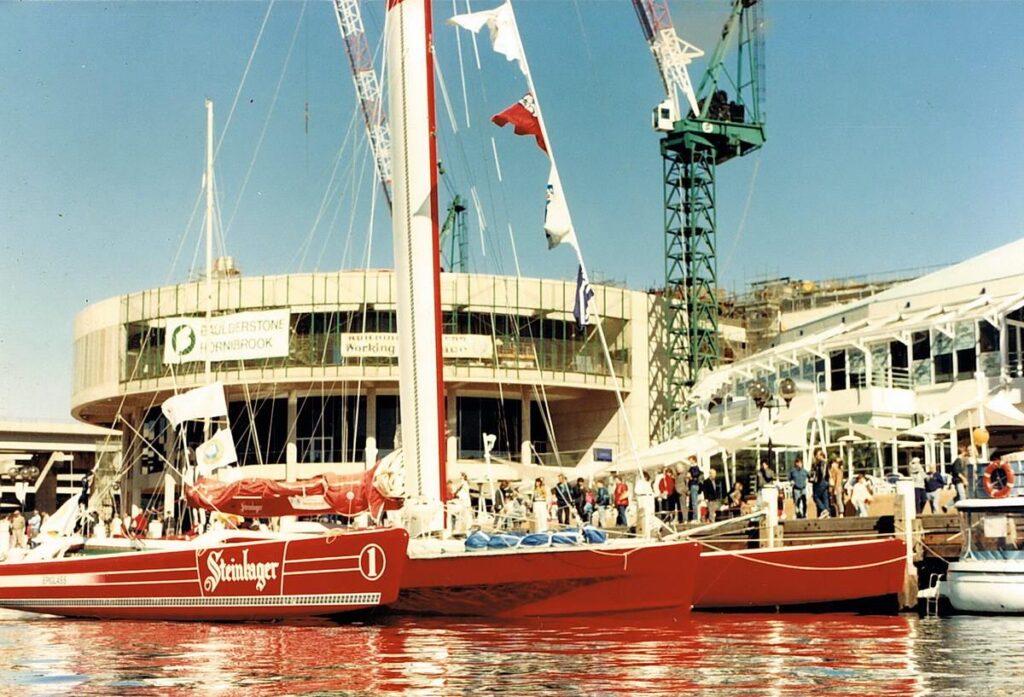

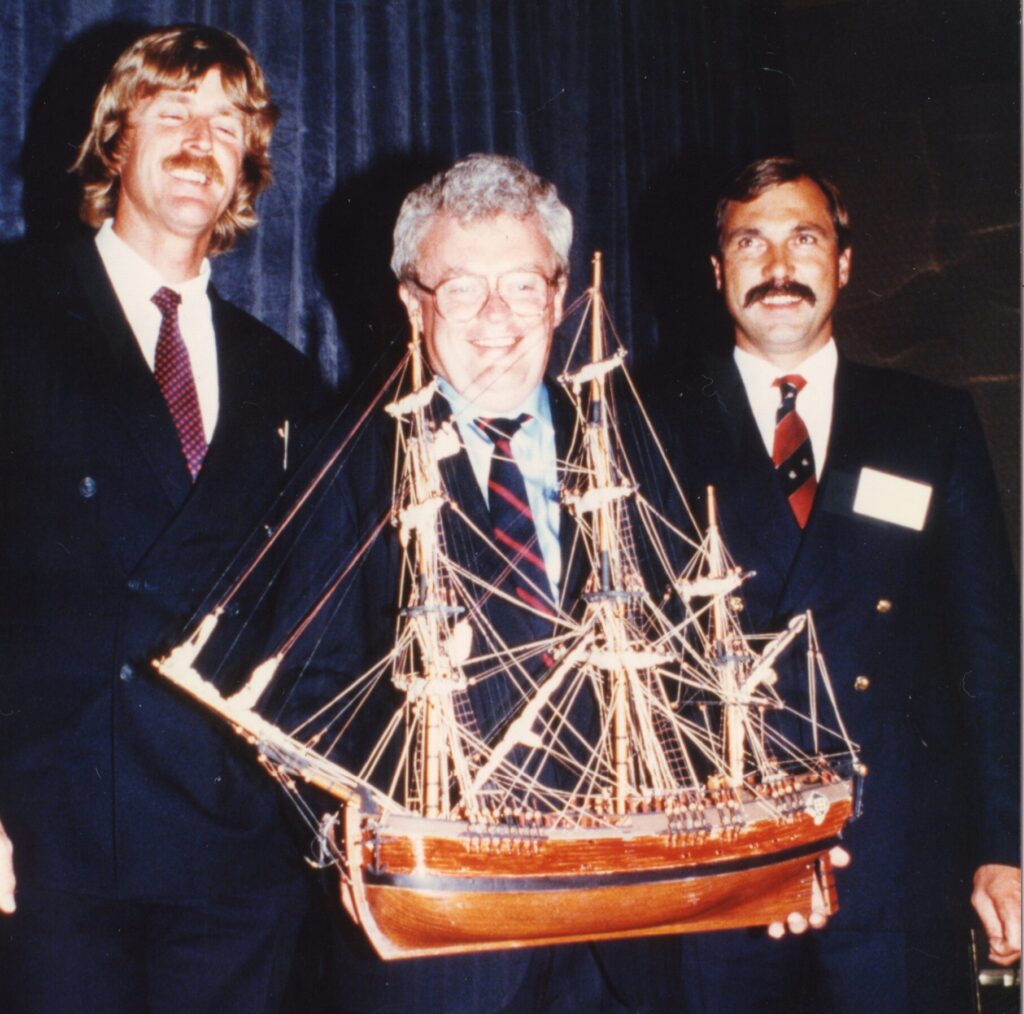
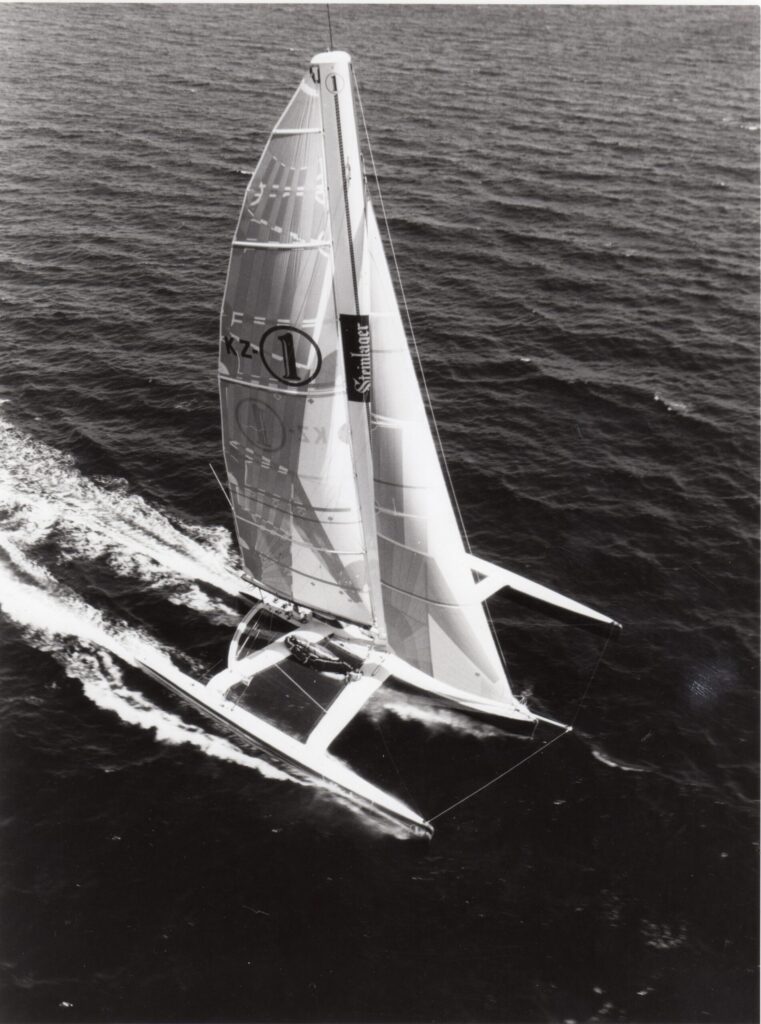
Sir Peter Blake arranged sponsorship from Steinlager for two boats, Steinlager 1 the trimaran built solely for the 1988 Bicentennial Race Around Australia and Steinlager II, built for the Whitbread race around the world.
Steinlager was well ahead in almost every leg. By the end of the race they were seven days in front of Verbatim and well ahead of the rest of the fleet.
Sadly, Sir Peter has passed on, however his co-skipper, Mike Quilter recently met with Race Director Guy Chester.
Mike Quilter
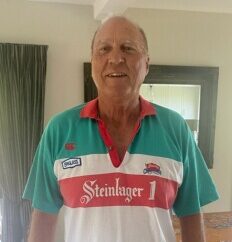
Mike has done just a little bit of sailing! He’s done 5 round-the-world races, won them twice with Peter Blake in the Whitbread and the Volvo races. Mike also won the 2000 World Race in Club Med, the big catamaran. We’re now used to those big multis sailing around the world, but that race of those big catamarans in 2000 was pretty amazing!
Mike has also been involved in just a few America’s Cups, starting out, with a being a sailmaker with Australia II in 1983. They won in 1983, so he must know a bit about sails! He then went on to the IACC boats, including a couple of wins, again, with Blakey and Blackmagic.
But the most important race that Mike won was the 1988 Around Australia race in Steinlager 1!
Guy Chester, Race Director, had a chat with Mike about his experiences in 1988. Mike explained the first night, where a gale hit the fleet.
Yeah, what was the first night like? Pretty, pretty rough. We went straight down into a southerly, I think, from memory, and big waves. Plenty of wind, and, sort of strayed into it. There was one guy lost overboard that night (Geoff Courtis, off Boundary Rider), so I was pretty willing.
But we got through it okay, and we got sort of far enough north and got out of it before the rest of the fleet did, so they had a bit more of a hammering than us.
It’s the only time I’ve ever vomited through nervousness, you know? Not that I was gonna die, but that I was nervous that we’d stuff it up and break the boat. But if you have to be in a storm, and I was with the right guy, that’s for sure.
So, there was a number of legs. Are the stopovers memorable?
The whole race was memorable. Quite a few stopovers. We ended up a long way ahead, and because you… it was a fixed time in the stopover, you sort of started 48 hours later. So, basically, after the start, we didn’t see much of the other competitors, which was a bit of a shame.
Stopovers with the whole fleet and leg restarts you get a bit more camaraderie, you help… get help from people, you know, because it’s not an easy race, it’s a long, long race. If you can get to know the other competitors, that would be a good thing.
7,000 miles, it’s not a Sydney Hobart, you know, it’s a long way, and it’s as much an adventure as it is a race. It’s a long way, and you’re out in the back of beyond, so you’ve got to be pretty self-sufficient, and you’re going to have a few problems, so…
Tell us about, getting out of Fremantle and across the Great Australian Bite and down around the west coast of Tassie.
We were a bit tired by then. And we got round, left Fremantle, that was good down to the corner, headed off across the Great Australian Bight, and I remember there was a big front coming up, big active front coming up behind us, and we used to sail along with, you know, either sleeping or sailing, and if Blakey was sleeping, I would tie a bit of string to his big toe and bring it up to the cockpit, so if I needed him, I could pull on the string, you know?
And I could see… we knew this front was coming, and I could see this black thing coming up behind us from the west, you know, and I thought, this is this is gonna be here soon, so I pulled my bit of string, you know, get up.
So he pokes his head up the hatch, and I said, here comes the front, and he said, yep, that’s it, and he closes the hatch and goes back to bed. But, yeah, after that crossing the Great Australian Bike was nice sailing, sort of a northerly off the land, just reaching along.
At one stage, I remember, there was, it’s Australia, there’s a whole bunch of, sort of, what we call cabbage white butterflies, small, sort of, one and a quarter inch butterflies, like, millions of them. Yeah. Off the coast, and so they’re heading south to nowhere, they’re heading south to Antarctica, but there was, it was such a big swarm of yellow, off white butterflies, and when I was sailing through it, you could walk around the trimaran, it was like being in a wind tunnel. You know, you could look up the sails, and you could see the flow over all the sails, and through the slot. Using butterflies, so that was pretty amazing.
And, West Coast of Tassie, after you went round, Saint Therese, had a bit of a problem. How did you go around the… around West Coast of Tassie?
We had no problem getting down there, other than they were getting pretty tired. I remember one night I came on watch, and Blakey went down below, and I couldn’t, for life of me, work out where the wind was from, or where we were heading, or what the numbers meant, and I was sort of sitting in the cockpit staring, you know, so tired, and luckily we’re on autopilot, so we’re heading in the right direction, but it took me about half an hour to wake up and work out where the wind was from, and what angle, you know, it’s… so it is a tough old race in that respect.
Going up into Tassie was okay. Leaving Hobart was pretty tough. It was really blowing down off the hills. And we sailed basically the top of Tasmania, just on the wingmast. Didn’t put any sails up, and just sailed along at 10 or 12 knots on the wingmast. It was really darn hard.
And, tell us about the boat. How big was Steinlager?
It was 60 feet by about… I can’t remember, but maybe 50 feet. Designed by David Allen Williams. It was a good boat, I think we were the only boat that got around that whole race in one piece. So, it’s a tough old race, you know?
How was it on Steinlager handling the 60-foot try with the two of you?
No, no problem at all. No problem at all.
You know, you could… we just had a roll-up jib, and we had a pretty good reefing system set up. No, we never got caught out, and we never had a problem in that respect. We never… other than the first night, which was pretty spooky.
Mike, finally, give us some sage advice for, people that are thinking of entering in 2028.
It’s, you know, you’re going all the way around Australia, you’re going up the, you’re going through such a different… all different climates. You’re going up the Barrier Reef, which I love, which was fantastic sailing. You don’t see much, because all you can see is some breakers out to sea of you, you know? But it was flat water, so beautiful sailing up there. Across the top, fantastic. Not for northwest, there was just nothing, you know, absolutely nothing.
And then back down into the… sort of into the Southern Ocean, and back down to Tasmania. So it goes through all climates.
It’s a long race through a lot of different weather patterns, and it’s an adventure as much as a race!